




In the early 2000s, we began to see a everywhere films scroll behind the DJ’s. then came time for VJ’s, who were mixing live images hypnotically. Today, nobody wants to dance all between four white walls. Mapping, LED, AV systems are everywhere, sometimes totally immersive, like the last Amon Tobin tour for his album ISAM. In addition to concerts and festivals, clubs wish now have permanent facilities. The Showcase is such redo all its decoration, with the help of architects cent.15. Heineken Green Room has met two years ago a forty designers who imagine the club of tomorrow. The result was presented at the Milan Design Week, Green Room and handed it to the Lounge the future this year. In Paris, the NYX Visual Studio realized the design Panic Room and Badaboum, or the insured scenography tour Visionquest, the label house of Seth Troxler and Ryan Crosson. Max Coisne says scenography in nightclubs is a well established trend. ” We have a lot world that asks us to redo clubs. People expect to see something other than empty room with a DJ at the bottom. The DJ’s are quite interested by such techniques and often they will have very specific ideas of what they want. Audiovisual shows allow touch a wider audience on another niche the album cover or flyer. experience is not only music, set design brings an extra dimension and allows create a special moment.


A Nous Paris – Bigtime Design Studios featuring Callin Fortis


A Nous Paris – Bigtime Design Studios featuring Callin Fortis


A Nous Paris – Bigtime Design Studios featuring Callin Fortis
We must consider the architecture of the place and the potential course people confirms Max Coisne. Badaboum for example, the structure LED was the only lighting in the room. Before to install it, so we studied traffic in the club and defined areas of interest for it to be the most effective, as front of the stage, where people dance. In Timewarp to Visionquest was wanted to occupy the entire room to create a kind temple with an immersive scenography which everything anyone can enjoy. Mapping, a technology that can project light or videos on large volumes, appears to hold the rope in designers. ” It’s a average outstanding term for designers. This is the same experience as attending a fire Fireworks, “according Callin Fortis.
Yet mapping starts to fade in favor LED, “which is back in force. The trend is to couple these technologies with robotics, with kinetic art. intelligent winches are used, that make shifting scenery. We even disturb more the vision of the spectator with optical illusions. ” But it’s not just technology that makes a club differs from others. At Gatecrasher, Callin Fortis has installed “kissing booths” “small recessed corners where couples could arise for kissing. “It is these little things that make we remember one evening. A light show 200 000 dollars will put you in the eyes, but in the end, these are smaller things you will remember. I grew up with Cirque du Soleil and Broadway shows. Sometimes just a broom and a well-lit stool for successful design.
Translated with Google Translate
Link to the online magazine:
A Nous Magazine – 2014
Link to downloadable PDF:
A Nous Magazine – 2014
MOST INFLUENTIAL HOSPITALITY DESIGN FIRMS
Over the past two decades, Callin Fortis and his firm have designed such well-known nightclubs as crobar, Gatecrasher, Cameo, Rain and Vinyl. Fortis says Big Time Design seeks to combine fashion, music, branding and design into one package. That approach is on display at Bubble Charlotte (shown), a recent project.
Capturing the spirit of New York, the city that never sleeps, the concept behind Crobar was to bring an urban familiarity to the space punctuating the overall ethos of nightclubbing with no boundaries of race, sexual orientation or income. Taking into consideration the building’s core function as well as the code and mechanical requirements the space was designed to provide the user with a unified platform. A tunnel pathway connects two distinct rooms and two music formats.
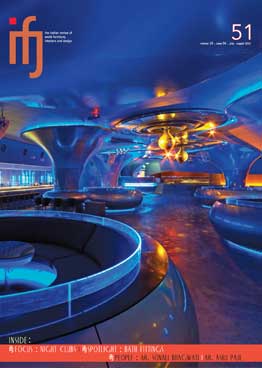
Read the July 2013 Issue of IFJ Magazine
Nightclub design aside, we’re excited to announce the book release of SECRET SOCIETY featuring Callin Fortis and Big Time Design‘s award-winning speakeasy inspired project, B BAR, located in the Betsy Hotel in South Beach. Secret Society is a “journey inside the global secret society of the members-only clubs and the modern speakeasies nearly impossible to access if you don’t already know of them.” – Christian Alexander, Author
Link to the book sneak peak: Secret Society
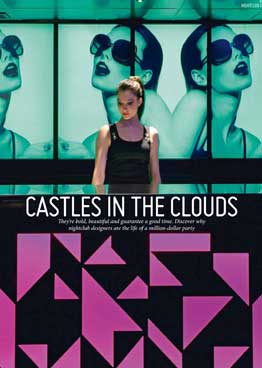
Big Time Design’s Callin Fortis speaks with Aspire, a business and luxury magazine exclusively published for business class and first class flights on Etihad airways. The article, Castles in the Clouds, says, “They’re bold, beautiful and guarentee a good time. Discover why nightclub designers are the life of a million dollar party.”
View Article:
Aspire Magazine
Big Time Design takes inspiration from nature to turn an empty getaway condo into a personalized boutique hotel. Callin Fortis of Big Time Design has transformed this bare, 2,300-square-foot, three-bedroom Miami Beach condo into a luxurious space resembling a high-end hotel suite — sophisticated, simple yet functional. Fortis has taken cues from the modernist principles of bringing the inside out and outside in. Fortis says, “Design is really about developing a personality, and people need to interact with it, and not to it.”
View Article:
Indulge Home Decor Magazine
View Online Magazine:
Indulge Home Decor Magazine
What, exactly, is global design? Is it a perception of aesthetic, doing business in an international arena — or something else entirely? At Miami’s Betsy Hotel, Hotel Design, along with sister publication Hospitality Architecture + Design sat down for breakfast with six designers and three sponsors to try to answer these questions among other subjects affecting the design industry.
View Article:
Hotel Design Magazine
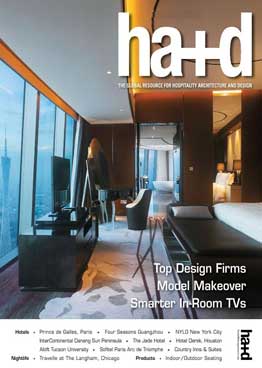
Designed by international hospitality designer Callin Fortis, principal of Big Time Design, guests enter the bar via a dimly lit passage that still suggests its service past. Fortis has included optical illusion as part of the magic that transforms this otherwise claustrophobic space. By using a reflective vinyl that acts as a mirror he ostensibly enlarges the visual feeling of space exponentially.
View Article:
HA+D Magazine
SOURCE ARTICLE: Elnorte.com
Situado justo frente a la playa de South Beach, The Betsy Hotel no sólo encierra en sus paredes la historia de toda una época, sino el lujo y la exclusividad que llegaron con los años a quedarse. Renovado totalmente en el 2008, este hotel que lleva su nombre en honor de Betsy Ross, mujer a la que se le atribuye la confección de la primera bandera estadounidense, se distingue dentro de las construcciones art déco de su época por su arquitectura colonial.
The last place anyone expects to find anything remotely hip is Ocean Drive. But the renovated Betsy Hotel has done just that with its speakeasy space, B Bar. Described as a “jewel box,” the lounge transports you to something akin to an obscure New York hot spot. Even if you stay at the Betsy, chances are you won’t easily find the lounge. To arrive at the entrance, you must descend a small set of stairs, walk through what looks like a service hallway, and knock on a nondescript door. Once you are permitted to enter (not everyone is so lucky), you’ll find the most gorgeously decorated space in all of the Magic City — a stark contrast to the safe design of the rest of the hotel. Let your eyes adjust to the dim lighting, and take in the dark hues, softly lit bar, and cozy yet elegant space. The real shocker here, though, is the low ceiling covered in reflective vinyl that can feel disorienting — particularly when a DJ turns up the bass and it vibrates.
Annointed “everything that was important in Miami” by Urban Daddy in 2009, B Bar is the latest creation of visionary designer Callin Fortis, the aesthetic master also behind iconic nightclubs Crobar, Cameo and Vinyl. Guests enter B Bar via a dim, hidden stairwell inside the subtly luxurious Betsy Hotel on Ocean Drive.
View Article:
Zink Magazine
“Shades of dark red, lavender and deep purple, a reflective black vinyl ceiling, and hand-cut Parisian crystal lamps add just the right complimentary golden glow and a sense of the ethereal to B Bar, the deep underground lounge now open at The Betsy Hotel on South Beach. Evoking the classic nightclub elegance of the 1920s, bespoke attired bartenders and wait staff evoke the classic elegance of the Prohibition era. But make no mistake: the cocktails flow freely here, from a Hendricks Gin-based, blueberry- and raspberry-infused Blue Velvet to the signature Josephine (as in Ms. Baker), an elixir of apricot liqueur and Thousand Flower runny honey. Yes, the vision of renowned designer Callin Fortis, of Big Time Design Studios, is indeed a designer Callin Fortis, of Big Time Design Studios, is indeed a stunning reality. As he says, “The B Bar is intentionally crafted with French mid-century contemporary styling which rests delicately on top of true nightclub bones.” We’ll drink to that. B Bar, in The Betsy Hotel, 1440 Ocean Drive, Miami Beach, 305.531.6100; visit thebetsyhotel.com.” – Aventura Magazine
View Article:
Aventura Magazine
View Web Article:
Aventura Website
“In a town with more clubs per capita than any place else on earth, it’s more and more difficult for a venue to stand out. That’s what made Crobar and then Cameo so appealing. The mix of whim and wile had not been seen since the days of Lapidus, and both venues remain legendary staples of what it means to truly do South Beach. The design mind behind the massive creations was one Callin Fortis, head of his own Big Time Design, and Ken Smith, co-owner of Crobar Worldwide. Fortis’s latest great creation is the B Bar at The Betsy and Crobar’s teamed with WMC for a pair of official pool parties destined to live in infamy. Niteside caught up with the keen cat on the eve of even more stunning bedlam.
You’re the fine mind behind Big Time Design, can you please give us a brief overview about the company and what it does?
Bigtime Design began in Chicago in 1999 after a grueling design school battle with kids a decade behind me. My vision as then a thirtysomething design and architecture ball of creative energy was to create a truly collaborative studio reminiscent of the famed masters who really created a conduit with which fresh new ideas, techniques in both design and manufacturing could find a home in a truly unique creative space. Enter, Bigtime Design.
One of BTD’s latest projects is the subterranean swing spot B Bar at The Betsy, which has a certain retro-tomorrow feel about it. Was there a single line or theme behind the design? I have been blessed by great spaces. By that I mean I typically work on large if not huge canvases. Bigger moves hide little mistakes. This space was, shall we say, size-challenged. It began as an unusable space in a basement of a historic hotel on Ocean Drive. The first magic move was to create the illusion that you were in a grand space yet small, secret and subtlety alluring. The big idea here was the ceiling treatment, which has turned out to be quite a unique feature in that it not only accomplished its goal of soaring volume overhead but it envelopes you in an ethereal fashion delicately underfoot.
What about your designs in general? Is there a consistent theme or idea from which they all spring? Absolutely. I live by this axiom: It is the big things that create the impression and the small things that create the memory. I am of German descent and with that comes a little thing called obsession to detail. There is a social story behind all my design efforts. If I can’t tell a story, I don’t begin to write. The muse for Betsy was a sultry post modern whip. She could recognize a fine single-malt and beat you at checkers and recite the last paragraph from “Catcher.” My kind of gal.
Which designers/architects do you find most inspiring and why? I am forever a student of architecture and design, though I switch up what’s on my nightstand more frequently than not. Lately, Zaha Hadid for her experiments with spatial quality in addition to a certain contained whimsy that I find creates a unique tension in all of her work. And Frank Gehry. Though obvious yet not present in my work other than deconstructive features when costs promote it, I remain fascinated by deconstructivism — also known as DeCon Architecture. I am inspired by his legacy and his ability to bend socio-political norms as supplely as the steel with which it is formed.
In addition to BTD, you and Ken Smith are the kingpins of Crobar Worldwide, which began in Chicago and now counts outposts all over the globe. If one was to ask for Crobar’s mission statement, what would you say? Ask Ken. Ken is nightlife visionary. By comparison what he does for nightlife all current club concepts are measured. If mega club life were to be measured in time, we should all be as lucky to have entertained as long as Ken.
How many cities are you in now and when and where will we see the next installment? We are working on an all-new Crobar Chicago, which is our hometown. That location will break every rule, boundary and expectation for nightlife as we know it. That one is personal. China is rocking. San Diego is on line, and Houston is under construction.
Crobar Worldwide also does outside productions all over the planet, and I know you cats have something planned for Winter Music Conference. Can you give us the details please? We have taken over the pool at the Eden Roc for a monumental partnership with WMC. Thursday is The Size Matters pool party with Steve Angelo and friends, which I believe is almost sold out. Friday is Circoloco from Ibiza, which is the one party I will not miss of the year. Production, mayhem and pure house music as we know and love it.
When, where and why did you cats start throwing outside parties to begin with? We started the off-premise concept with Punta Del Este and San Tropez in the mid 2000s. We found that the opening weekend of a club typically is the most mind-blowing 48 hours you can create. Taking our show on the road, as it were, gave us the opportunity to re-create opening after opening after opening again and again. Our party in San Tropez in the season of 2003 was one for the record books.
Speaking of parties, can you name a few of the best you’ve thrown at Crobar over the years?Miami — the first year of “F— Me I’m Famous” with David Guetta. Eric Morrilo and Puffy at Crobar New York. Black Eyed Peas live at Crobar NY.
When you’re not hanging in one of your own joints or parties, where do you like to go? Michaels Genuine — great outdoor dining, great service, great crowd. Red Light — oh my God, the food, the atmosphere and the fact that it is Miami’s own Florent, the original New York Meatpacking institution. The bar scene is sort of same-same for now for me but if I go anywhere it would be to hang with Carmel Ophir and Big Chris at The Vagabond. Little old school SoBe, with a pinch or two of Downtown. Just right.”
SOURCE ARTICLE: Miaminewtimes.com
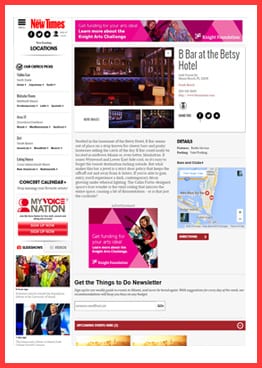
“Nestled in the basement of the Betsy Hotel, B Bar seems out of place on a strip known for cheesy bars and pushy hostesses selling the catch of the day. B Bar could easily be located in midtown Miami or, even better, Manhattan. It oozes Wynwood and Lower East Side cool, so it’s easy to forget the tourist destination lurking outside. But what makes this bar a jewel is a strict door policy that keeps the riffraff out and away from A-listers. If you’re able to gain entry, you’ll experience a dark, contemporary décor glowing under ethereal lighting. The Callin Fortis-designed space’s true wonder is the vinyl ceiling that mirrors the entire space, causing a bit of disorientation – or is that just the cocktails?”
VIEW THE FULL ARTICLE AT MIAMINEWTIMES.COM
VIEW AS A PDF
“Echoing the privileged pomp of Prohibition days, the B Bar in the basement of The Betsy has just opened in Miami Florida, offering a sumptuous take on a speakeasy, designed by Callin Fortis of Big Time Design Studio.
Guests make their way down a wood-paneled staircase into a jewel box-esque space in opulent shades of red, lavender and deep purple, offset by a highly reflective, black vinyl ceiling. Hand-cut crystal lamps cast glinting shadows across low-slung burgundy velvet couches.
“The B Bar is intentionally crafted with French, mid-century contemporary styling which rests delicately on top of true nightclub bones,” said Fortis.
Fortis has been crafting decadent nightclub dens for over 20 years, designing spaces like Crobar, Gatecrasher, Cameo, Rain and Vinyl.”
View Web Article:
Boutique Design
View Web Article:
Boutique Design Online
“The Gatecrasher lion, so symbolic of the brand’s glory days, may have hung up its glow sticks and laid down in the ashes of the Sheffield club, but Gatecrasher has reared its head once again – now a very different beast – and come back bigger and bolder than ever before with international nightclub designers Big Time DeThe Gatecrasher lion, so symbolic of the brand’s glory
days, may have hung up its glow sticks and laid down in the ashes of the Sheffield club, but Gatecrasher has reared its head once again – now a very different beast – and come back bigger and bolder than ever before.
Following the closure of Bed nightclub and the fire of Gatecrasher Sheffield, only GatecrasherLovesNottingham and Gatecrasher Seven in Leeds remained, and the dance brand’s fans waited with baited breath to see if a new clubbing phenomenon would rise.
And rise it did, a whole 65 feet into the air, in the form of a £5 million, 2,400-capacity nightclub in central Birmingham, following the acquisition of The Works. The Miami-influence venue spreads across a staggering 35,000 sq ft, comprising four levels, four individual rooms, six feature areas and nine bars. Says Gatecrasher founder and MD Simon Raine: “We had no intention of taking an old Works nightclub, but when we visited and I stood on that balcony and looked down I just thought ‘wow what a fantastic space’.”
The superclub has surpassed all expectations and – along with matter at the 02 – was probably one of the most impressive large-scale UK clubs to open in 2008. This is evidence of Raine’s ambition to revolutionise Upper Broad Street, create an impact on customers and shake up the UK’s clubbing scene. Uninspired by the UK’s club design, Raine looked abroad and instantly became excited by the work of renowned US designer Cal Fortis, of Big Time Design.
Fortis is responsible for the award-winning designs – best interior design, best renovation – of the world’s most famous clubs, including Crobar New York, Crobar Chicago, and the Cameo Theater in Miami (mondo*dr 17.4). Says Raine: “He understands nightclubs better than any designer; he sees a nightclub from many different perspectives, as an operator, a creative designer and from the point of view of the clubber. We are taking some big risks in the UK with some of his designs, but these are risks that he has already taken and which work exceptionally well in the US market. Our matrix wall is like the one in Cameo, but he’s re-designed it, so it’s the future of where Cameo Miami was. He’s made it bigger, better, brighter and with more features.”
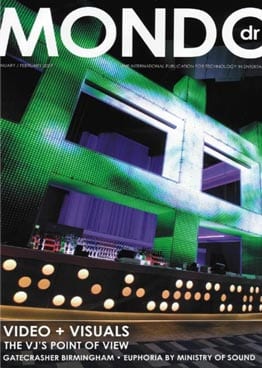
The matrix wall Raine talks of is the most iconic of many spectacular, bespoke architectural features that transform the venue into a stage for spatial drama. The first thing that strikes people as they enter the cavernous main room is this 11 metre structure, which looms overhead, stretching from floor to ceiling, built from square LED panels, and displaying light, graphics and video. It has a three dimensional design, with three vertical columns intersected by two horizontal sections, and has been covered on all sides by LED panels brought over from China by Lighting Effects Distribution.
Damian Gale of Willow Sound & Vision, which installed the lighting, video and LED video at the club, says: “The Video LED columns were a unique challenge due to the sheer scale of installation, this work along with the back colour change took approximately 1,000 working hours to install, [along with Cannock Electrical and Mechanical Installation]
We have performed many video LED installations but never 11 metres high and 20 metres wide! We feel that Gatecrasher has performed an amazing task changing the existing venue without major structural building changes; what they have created gives the customer a unique experience wherever they stand, this is a hard act to follow.”
Definitive Media’s Stuart Wilson made the content for the matrix by producing over 250 bespoke video LED loops, specially designed to work with the 3D effect of the display. With the 3D con- struction of the LED display, the team had to design the visuals with pixel perfect mapping, which allowed the visuals to wrap around the structure seamlessly. Each video sequence was split into layers and assigned to each face of the wall, which gave the ability of full control over the 3D display. The playback system is ArKaos DMX with LED mapper to match the screen resolution to the LED display. Around the rest of the room, Pioneer DVJs combine with Resolume graphics computers to give a fresh twist to visuals, mixed by the new Edirol V8 vision mixer and Projected by five BenQ projectors.
Elsewhere, Gatecrasher Birmingham (GB) is coloured by vibrant images, open floors, catwalks, sin bins, dancefloors, kissing booths, and a 14ft mirror ball DJ booth. Fortis describes the design of the club as a high-concept homage to New York’s Palladium and the era of disco. His influences stem from the mid-’80s when Ian Schrager and Steve Rubell’s post Studio 54 New York sin bin, The Palladium, was in full swing.
Fortis explains: “There was a freer sensibility to nightlife then – everyone mixed on the dancefloor, clubland was full of sex appeal and sizzle. I want to bring back that kind of danger and rawness to clubland; Scarface meets the dark side of Saturday Night Fever, meets a Brazilian hooker in an analogue, not digital world.” Raine adds: “Gatecrasher Birming- ham is a film set, a huge expansive studio space with oversized architectural pieces inserted to create a juxtaposition between Fear & Loathing In Las Vegas meets the visual aspects of Blade Runner. It’s more than the music, glamour and flashing lights of previous Gatecrasher venues.”
To create and implement such an eclectic and complex design scheme, Raine hand-picked “the best design team in the world”, drawing on the expertise of Fortis and Matt Rawlinson Design Ltd for conceptual design, who worked in collaboration with overall design project managers Design at Source, led by Stuart Trett, and main contractor Phelan Construction. Trett explains the design process: “Big Time Design did the conceptual design and big set pieces for the main room and Matt did conceptual design for Bed, whilst we pulled all of those areas together, made them happen and in addition to that did the entire design for Mansion, Orange Pop and all the intermediate areas.”
He continues: “Raine wanted to absolutely get away from what’s become a relatively stagnant and jaded UK club blueprint for nightclub layouts, which is what Big Time brought to it by getting the seating out and onto the dance floor and breaking down that very large space.” Rows of long arching blood red leather ‘sin bins’, balconies and a section of elongated steps that are meant to represent large museum steps for lounging on, mean that the surrounding areas of the dancefloor are all part of the action. To the left of the dancefloor is a ceiling-high feature wall, which towers over the entire room. Huge lexicon panels are adorned with translucent iconic prints, alternately portraying a queen and a monkey. In front is a platform for GB’s theatrical entertainers, who can also perform on the trapezes set high above the heads of the crowd.
Although the main room is the key discussion point of the venue, the entrance to it was pivotal to the design because the journey to the main room was meant to be instrumental to its impact. One past the initial turnstyles and up the stairs, clubbers are met with a preliminary ‘departure lounge’, meant to echo the experience one has at an airport before they embark upon a trip. The room hints on the glamour within, with pendant chandeliers, ripple fold drapes and reflective ceilings. A 180 degree turn takes guests down a long futuristic tunnel, with colour changing lights and a glass wall to one side. Around the corner is a corridor covered in old ‘crasher’ posters – a brief encounter with the brand’s heritage – before being suddenly swept into its astonishing new world, the main room of GB. Trett says: “The idea of the turnstyles on the way in and the tunnel makes it a bit like standing in a Disney queue line and wondering when you are going to get in.” At the back of the main room lies Orange Pop, a separate room with its own DJ, sound system and lighting effects. Dramatically different in design and vibe to the main room, Orange Pop blends a kaleidoscope of coloured lights and furnishing with pop art Lichtenstein wallpaper, rubber floors and playful LED displays on the backbar depicting different lettering. Another play on words – a common theme throughout GB – is featured on the bar top; a yellow LG Hi-Mac bar is etched with writing, which was fabricated by Multi Surface Fabrications Ltd, along with the white rectangular bar in the Posh room. Says Trett: “The writing is by Roy Lichtenstein. It’s about the meaning of fame and success – you might be rich and famous, but everybody drinks the same Coca Cola, goes to the same places and wears the same shoes. So it’s tongue in cheek, poking irony at the fact that everybody is at Gatecrasher thinking they’re cooler than cool.”
Designers Republic has implemented a series of overt signage around GB, identifying different zones such as ‘Powder Room’ and ‘Smoking Kills. This Way’. In Orange Pop, small ‘kissing booths’ look through to the main room, ensuring people aren’t detached from the action. Above Orange Pop on the open mezzanine level is Posh, a private bar with mood lit seating and off from the main room is Mansion, catering for the mainstream crowd with R&B and pop. On the third floor above Posh is Bed, which can function as a separate club. Matt Rawlinson (who designed GatecrasherLovesNottingham and Gatecrasher Seven) created the concept for Bed in the initial stages of planning, as a space for the older, more sophisticated crowd. A central dancefloor, circular lighting rig and ten mirror balls give the room a disco feel, whilst the elegant bar area is flatteringly covered with leather panels that form a curve over people’s heads and reflect the ambient lighting.
Each of the four music zones – main room, Bed, Mansion and Orange Pop – will play different musical genres each night. Going against the grain of its past, GB will host indie nights on a Friday and launched with DJ sets from The Editors and Babyshambles’ Adam Ficek. Says Raine: “Deep down we still love dance music and house music, but most people in the UK don’t want dance music. Gatecrasher has always been about music, it’s about delivering an experience with music.”
Raine states that the drama and impact of the main room demands a big sound. GB shouldn’t have a problem packing the punch due to its custom made sound system by Opus Audio, which is in excess of £150,000. Each speaker cabinet has been built for a specific area in the club. Opus Audio also provided the custom audio control and amplifiers for the venue. All speakers are driven with 30 Opus HD series High Definition power amps and 10 Opus XS series Loudspeaker management systems. XTA and BSS processors were used for overall system delay.
You’ve got to give it to Gatecrasher for having the balls to develop such a bold new beast. Raine is well aware of today’s tough trading conditions. He says: “We chose Birmingham as it’s the second largest city in the UK with an immediate audience of three million people on the doorstep and historically Birmingham has been a great clubbing city.”
Gatecrasher is currently in negotiations with international territory licence partners to develop Gatecrasher branded venues, and are actively seeking new partners across the globe. Meanwhile the international events and touring side of the business will continue to operate across the globe in over 20 countries worldwide, seeing Gatecrasher parties in Russia, the Ukraine, Hong Kong, the Phillipines, Singapore, Kuala Lumpur, Australia, New Zealand, Bali and Brazil to name a few. But of Gatecrasher’s immediate focus, Raine states: “Our most important focus at the moment is GB, this will set one of the boldest statements. Then our next stop is THE return to Sheffield.” Across the road from the old lion’s resting bed in Sheffield, the earth is preparing for a new beast to take form.”
View Article:
Mondo Magazine
View Article:
Mondo Magazine Online
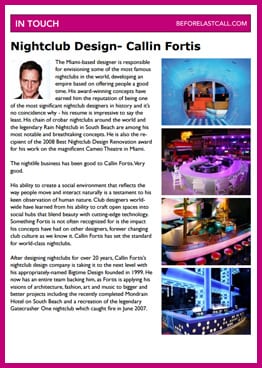
The Miami-based designer is responsible for envisioning some of the most famous nightclubs in the world, developing an empire based on offering people a good time. His award-winning concepts have earned him the reputation of being one of the most significant nightclub designers in history and it’s no coincidence why – his resume is impressive to say the least. His chain of crobar nightclubs around the world and the legendary Rain Nightclub in South Beach are among his most notable and breathtaking concepts. He is also the recipient of the 2008 Best Nightclub Design Renovation award for his work on the magnificent Cameo Theatre in Miami. The nightlife business has been good to Callin Fortis. Very good.
His ability to create a social environment that reflects the way people move and interact naturally is a testament to his keen observation of human nature. Club designers worldwide have learned from his ability to craft open spaces into social hubs that blend beauty with cutting-edge technology. Something Fortis is not often recognized for is the impact his concepts have had on other designers, forever changing club culture as we know it. Callin Fortis has set the standard for world-class nightclubs.
After designing nightclubs for over 20 years, Callin Fortis’s nightclub design company is taking it to the next level with his appropriately-named Bigtime Design founded in 1999. He now has an entire team backing him, as Fortis is applying his visions of architecture, fashion, art and music to bigger and better projects including the recently completed Mondrain Hotel on South Beach and a recreation of the legendary Gatecrasher One nightclub which caught fire in June 2007.
View Article:
Before Last Call
(Birmingham) – An interview with Callin Fortis, founder of US-based Bigtime Design, on his conceptual design for the new £5 million Gatecrasher Birmingham. Callin Fortis, founder of Bigtime Design, is an internationally acclaimed designer famed for big nightclub projects that impress even the A-list celebrities. Known for designing and branding the award-winning series of Crobar nightclubs in the US, Cal has now cast his conceptual creativity towards the new Gatecrasher Birmingham. He explains why this “modern day Coliseum” is amongst his best projects to date and defines the notion of “the sociology of good design”.
Could you explain the concept for the Gatecrasher project?
I see Gatecrasher Birmingham as a modern-day Coliseum of sorts, with a Duomo level of drama matched with the sex appeal and sizzle of the Palladium. I am a big fan of Roman architecture. In terms of the way the Romans were able to organise masses of people for events, and have people be manipulated over and through space, the Coliseum is brilliant. The Gatecrasher concept is somewhere between that and the notion of club design being akin to a rollercoaster, where people are taken on a ride.
What were your first impressions of the Birmingham site?
It was overwhelming. There are very few naturally palatial spaces in the world and that was certainly one of them. It was a little daunting at first, particularly because it had a nature theme in its prior incarnation as The Works. So when I initially looked at it, it was a tad overwhelming – I’m not used to seeing spaces that are so large, overwhelming and themed. But it was just so dramatic and I was unbelievably impressed. The Birmingham site is a truly amazing space. As a designer who in the past has been given the reins to making mega-space manageable, to receive the gift of this space, which is a clear span with very few columns, tremendous volume and ceiling height, it’s a designer’s dream. There are few spaces in the world that evoke an emotion simply through experiencing their base architecture alone, but this is one of them. Typically when one thinks of space in emotional terms, rarely does one think of space that can house a premiere, world-class nightlife theatre. History tells us that classic places for entertainment and theatre are basically architectural remainders from our past.
How did the concept evolve during the planning process?
Do to the sheer size of the venue, which was somewhat daunting in the preliminary stage, we literally broke the site down graphically into little spaces colour-coded within the overall footprint. Someone in our studio printed a largescale plan with all the areas toned specific colours. From there we began to name the spaces. Through the concept stage, which is really a storyboard done with words as opposed to lines on paper, a singular theme emerged. That of the building itself being a terminal – a terminal as a metaphor for nightlife. A terminal that represents departure, arrival, meeting new people, experiencing new places. What became present was Gatecrasher: departure nightlife. As in life, good design is about the journey, it is about the experience and emotion one can evoke by involving the user in the experience through space. A modernist goal became omnipresent in the new Gatecrasher. If we can take the patron on a trip, a ride with destinations unknown yet to be explored, then we have succeeded in our design.
You’ve said Gatecrasher is among your best work to date, can you enlarge on that?
I am a big club, big space designer. Simply put, there are very few nightclub designers that can make sense out of large spaces and create intimate and exciting spaces that live and breath. Scale is something you feel. Manipulating scale is not something you learn in school, it is an instinct and an experience. I have created award-winning designs (Best Interior Design, Best Renovation) in several US cities (crobar New York, crobar Chicago and the Cameo Theatre in Miami). Crobar NY was a crowning moment in terms of a complex space with a complex story. New York was recovering from a year of mourning after September 11th. We created a space and an experience that got New York back out, back to the dance floor and back to social play where everyone was equal. Gay, straight, black or white. The dancefloor unites all people. This is the universal language that crosses all borders – no passport required. Though much more of a political message and a dissection of the human sprit, Gatecrasher Birmingham has all the fun, the play, the whimsy and certainly more sublime bells and whistles than, I would venture to say, any true nightclub in the world. The new Gatecrasher deserves to be a piece of nightlife evolution and an expansion of its past, which is regarded worldwide as one of the founders of true clubbing as a lifestyle. I am proud and honoured to have a part in the future of this world class brand with a respectful nod to its past.
You’ve talked before about the notion of “Sociology of good design”…
Especially in big nightclubs, designer often creates borders, walls and rooms that all tend to be homogenised. My philosophy is that that the nightclub is a place for everybody to be equal, white, black, straight, gay, male, female, high income, low income. On the dancefloor, you don’t care if the person next to you makes 10 per cent of what you make, or if their clothes cost 10 times what yours did. It doesn’t matter because it’s the one place where everybody can mix. So I always try to take a more of a social approach to how I develop a space and keep the borders between the spaces very transparent.
Is there a common design DNA to the key international projects you’ve worked on – the consistent threads of design innovation or creativity?
Yes. What I try to do is manipulate space, especially in places that have so much volume. It’s a trick that Steven Holl, one of my mentor architects, develop – the notion of taking standard details at human scale, and then multiplying them by 10 to make the user feel like they are participating in the event, as opposed to just looking at it. In all my music spaces, everything is human-scale times 10, like the disco mirrorball for example. You see it and think :it’s a mirrorball. But the you go, Oh it’s huge!
Architecture and design are distinct disciplines, how do you ensure they synergise in your projects?
If the architecture has integrity, then the design will be a natural progression from it. If the architecture is in place and, say, I were to be hit by a bus before I finished the design, the initial intention would mean that of the functionality of the place will be equally as good whoever finishes it. That’s key. For example, Crobar Miami has those big Art-Deco fin structures around the dancefloor. I designed them in an off-white Art-Deco concrete style. However, once they were in place, if someone decided they should be painted in zebra stripes, the fins would still function the same way. It wouldn’t have mattered.
Light and colour are key to your design aesthetic. How do you manage and coordinate them?
We know that when people are in the space, they want to want to be entertained by the environment, so the environment must provide entertainment. Elements of the design fuel each other. Nightclubs can be monochromatic and dingy, and one problem is that a lot for nightclub designer and architect under-light – they think darker is better. But light and dark are relative to one another, so if you have one area that’s light next to another that’s comparatively underlit, the second areas will still seem very secluded, and the people who don’t want to be seen will still have a place to go. At the same time, the whole the club is providing a sense of drama.
What is your personal – rather than professional – experience of some of the clubs you have designed?
I find myself absorbed in the experience and we’ve had some classic moments. One special moment was when Puff Daddy discovered house music at Crobar Miami. He got on stage with Erick Morillo to play the saxophone. Erick was spinning a sexy house beat and Puffy was standing in front of him paying the sax, then two of Puffy’s singers got up and started singing along to the music. To watch people in the space with their eyes glued to the ceiling, it doesn’t get any better than that.
You made a big splash with the launch of The Cameo Theatre in Miami…
It was a big event, though not as big as the Crobar in New York. Miami is a village compared to New York. It’s also kind of the “American Riviera”, so that became the theme of the night. We had 3,000 people all dancing and standing on banquettes…
Your clubs attract lots of celebrities. What do your perceive as their expectations from a club? How does they differ from regular guests?
People typically think celebrities want to have their own space or room, and that they want to be shuffled in through the back door. In reality, they want to feel secure enough to have their own space, but they want to be in it – they want to feel connected.
Which celebrities have guested at Big Time Design’s projects?
Regular customers of ours are Puffy, Adrian Brody, Boy George, George Clooney – he loved the place – Jennifer Lopez and Roberto Cavalli. And Harrison Ford. You’d never think Harrison for was a nightclub guy, but he loved Crobar and he would have a blast. And Matt Damon married one of the bartenders from Crobar Miami!
What is your ultimate aspiration for Gatecrasher Birmingham?
That the club is the rebranding of a concept that already has so much integrity. We always looked over the water to you guys for inspiration – fashion, music, nightlife, everything. To have an arena as big as this with someone like Simon driving it, that would be my biggest smile.
View Article: Mondo Magazine